Karaims – one of the smallest Turkic ethnic groups living in Lithuania. From the perspective of language and ethnogenesis, they belong to the oldest Turkic tribes—the Kipchaks. The Karaim language, which belongs to the western Kipchak branch of the Turkic language family, is still alive and used in both daily life and in rituals and liturgy.
The foundation of the Karaim faith (Karaism) is the Old Testament without later additions or commentaries, interpreted individually and independently of religious authorities. This personal interpretation of the Holy Scripture is the main principle of Karaism, and the Old Testament and the Decalogue set forth the core moral norms.
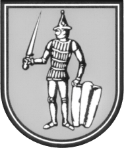
Relocated from Crimea by Vytautas at the end of the 14th century and settled in the Grand Duchy of Lithuania, the Karaims formed a distinct community. They had administrative and legal self-government led by a local elder (voit), as they had enjoyed privileges granted by the rulers since the 15th century. In the Grand Duchy, they were divided into two estates: civilians, engaged in gardening, crafts, and trade, and military members. Their military tradition is reflected in the spear and shield motifs stylized in the Karaim coat of arms.
Karaim folk art is characterized by plant and geometric ornamentation, especially well-preserved in liturgical textiles. The same motifs were used to decorate manuscripts and the interiors of their temples—kenesas. Today, two kenesas remain active in Lithuania: one in Vilnius (Žvėrynas) and one in Trakai (on Karaimų Street).
Clergy are elected and divided into junior (hazzan) and senior (ullu hazzan) ranks. The highest spiritual and secular authority is the ḥakham. The last ḥakham of the Polish-Lithuanian Karaims was the orientalist and Doctor of Philology Haiji Seraya Khan Shapshal (1873–1961), who served in this role from 1928 to 1940.
The oldest surviving Karaim literary works have been preserved in manuscript form. These are theological and legal works by Karaim theologians, as well as religious hymns.
Handwritten books were popular among the people. Karaim families in Crimea and Lithuania also owned similar handwritten books, though their content varied. These books were called majmu’a (Arabic for “collection”). In addition to prayers and ritual texts, they contained various poetic works and folklore texts.
Since the late 19th century, Lithuanian Karaims used prayer books edited by Feliks Malecki, published in Vilnius in 1890. A collection of religious prayers was compiled and published in 1935 by Simonas Firkovičius. In 1993, senior clergyman Mykolas Firkovičius published a collection of daily and special occasion prayers, and in 1994 – a book of Psalms and a Karaim language textbook entitled “I Am Learning Karaim”.
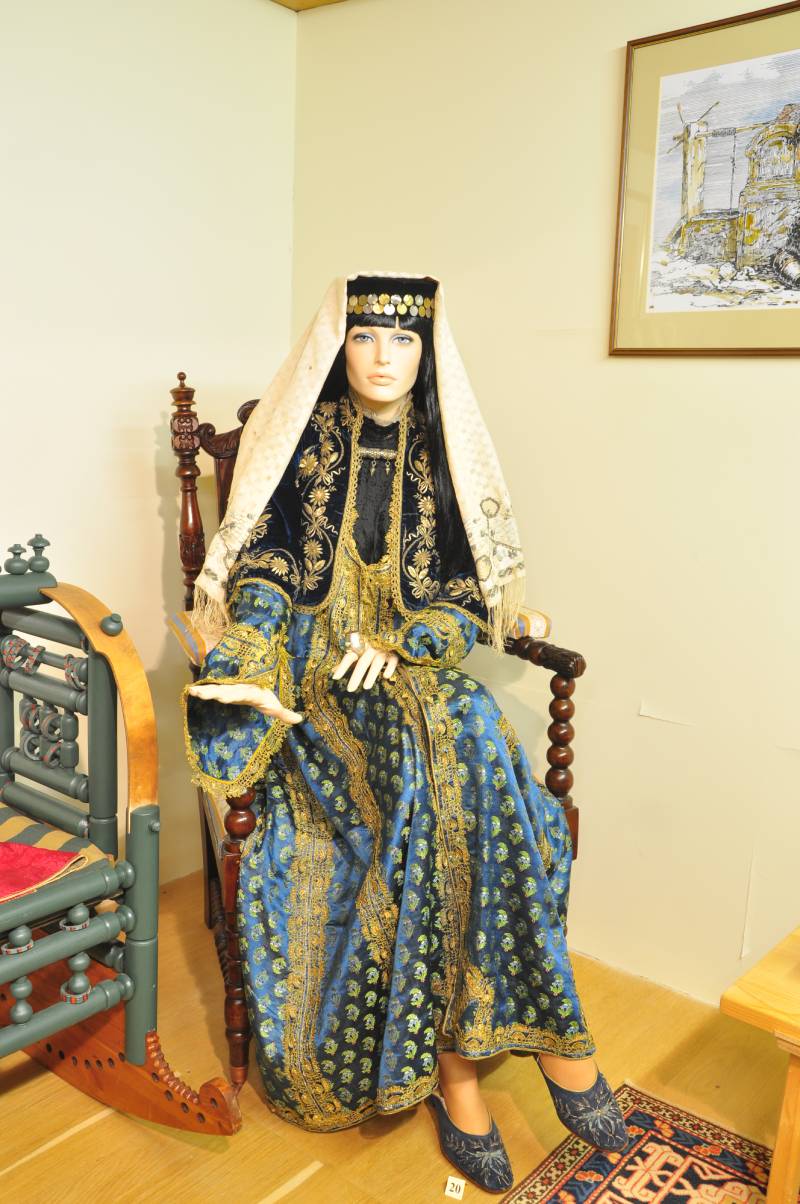
Traditional national clothing was lost by Lithuanian Karaims long ago. As early as the 18th century, it became unpopular. Marriage contracts from the early 18th century listed the bride’s dowry, including head coverings worn by married women. These are now museum exhibits, as by the 19th century Karaim clothing no longer differed from that of the local population.
Thus, the exhibition presents a man’s garment – a robe tied with a sash or belt – and a cap, a clergyman’s robe with the front embroidered in gold thread with plant motifs, and a festive woman’s outfit. Large jewelry pieces and shawls were popular.
An interesting exhibit is a cradle, which used to stand in the “women’s” side of the house. All its parts were fastened with wooden nails, as iron nails, which were used for coffins, were forbidden in cradles. Everything that reminded of death had to be removed from around the infant.
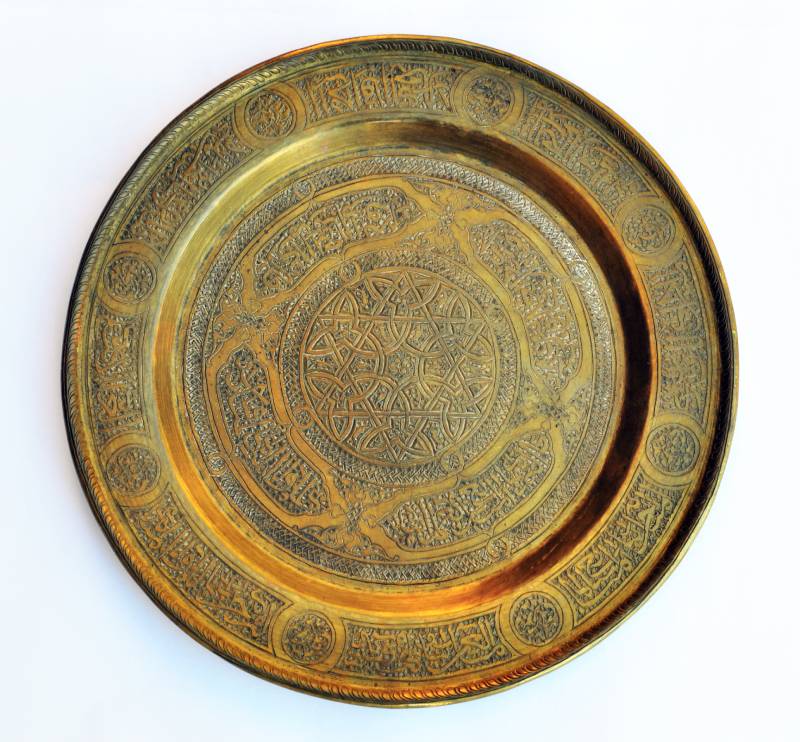
Also, on display are household and domestic items used by Karaims: metal dishes, trays (people once ate while sitting on a carpet), a vessel for warming wine, handmade napkins, covers, and rugs.
Karaim annual holidays are set according to the lunar calendar.
The first major holiday of the year is Passover, lasting an entire week. It commemorates the Exodus from Egypt and liberation. In preparation, large quantities of flatbreads called tymbyl are baked from unleavened dough (nothing leavened, not even bread, is consumed from the first to the last day of the festival).
Pentecost (the Green Holiday) is always celebrated on a Sunday – the fiftieth day after Passover Sunday. On that day, homes are decorated with greenery, and the floors are strewn with calamus. It is also the "cheese day": cheese-filled pastries are made, topped with sour cream and butter, then baked. A seven-layer pastry with curd, called katlama, is also baked – the seven layers symbolize the seven weeks since Passover.
Before World War II, Karaims celebrated the ancient holiday Orach Toyu, or “Sickle Festival.” Every year after the harvest, Karaims would walk in a solemn procession, singing hymns and carrying a wreath woven from grain crops. The wreath was hung in front of the altar and remained there until a new one was brought the following year. The grains from the old wreath were scattered into freshly tilled soil.
Fasting holds great significance in Karaim rituals.
The first fast, which is also a day of remembrance for the dead, occurs in June or July. At the start of Lent, the whole community gathers in the kenesa for a memorial service for the deceased. After the service, people hurry to the old Karaim cemetery in Trakai. There, at the oldest grave, the senior clergyman chants the lament Syjyt Jyry, written by Solomon of Trakai (1650–1715) in memory of the victims of the 1710 plague.
Afterward, the community proceeds to the current cemetery. Prayers are said by the graves of senior clergyman S. Firkovičius and his wife, after which people disperse to visit the graves of their own relatives.
No candles are lit in Karaim cemeteries, instead, flowers are burned. Upon approaching a grave, people greet the deceased, and upon leaving, they say farewell and gently touch the grave with a handkerchief. Karaim Lent lasts for an entire month and ends with the Day of Sacrifice – Kurban.
Since 1988, Lithuanian Karaims have been organized as a national community and actively participate in public life. Today, two Karaim community organizations are active: the Karaim Religious Community of Lithuania and the Cultural Community. Karaims living in Lithuania (currently about 260 people) maintain ties with Karaims in Poland and Crimea.
Seraya Shapshal was born in Bakhchisarai (Crimea) on May 8, 1873.
In 1894, he enrolled in the Faculty of Oriental Languages at the University of St. Petersburg (specializing in Arabic, Persian, Turkish, and Tatar languages), graduating in 1899 with a first-class diploma. From 1900 to 1908, he lived in Persia (Iran), where he served as a tutor to the heir to the throne. Upon returning to Russia in 1908, he taught at the University of St. Petersburg. In 1915, S. Shapshal was elected hachan (spiritual leader) of Taurida (Crimea), but in 1918 he emigrated to Turkey. At the end of 1927, he was elected hachan of the Polish Karaim community, and in 1928 he arrived in Vilnius (his inauguration took place on September 11, 1928). As both the spiritual and secular leader of the Karaim people, S. Shapshal continued his scholarly work: between 1930 and 1939 he taught the Turkish language at the Institute for Eastern European Studies and at the School of Political Science, and he was a member of various academic societies. Having collected a rich assortment of museum exhibits from Crimea and the Muslim Near East, S. Shapshal supplemented this collection with valuable Lithuanian Karaim artifacts and initiated the construction of a Karaim museum in Trakai. The cornerstone ceremony took place on July 6, 1938. However, the outbreak of World War II halted the museum’s construction. The collection, kept in S. Shapshal’s apartment in Vilnius, became the foundation of the Museum of Karaim History and Ethnography, which operated from 1941 to 1951. Later, the inventory and exhibits were transferred to the Lithuanian Academy of Sciences and to the Museum of History and Ethnography (now the National Museum of Lithuania). From 1947, S. Shapshal worked at the Institute of History of the then Academy of Sciences of the Lithuanian SSR. He died on November 18, 1961, and is buried at the Karaim-Tatar cemetery in Vilnius (Liepkalnis Street).
On November 18, 2011, Trakai History Museum honored the memory of the founder of the Karaim museum. A commemorative plaque was unveiled on the museum wall, and the Karaim ethnographic exhibition was named the Seraya Shapshal museum of Karaim nation.
Gallery